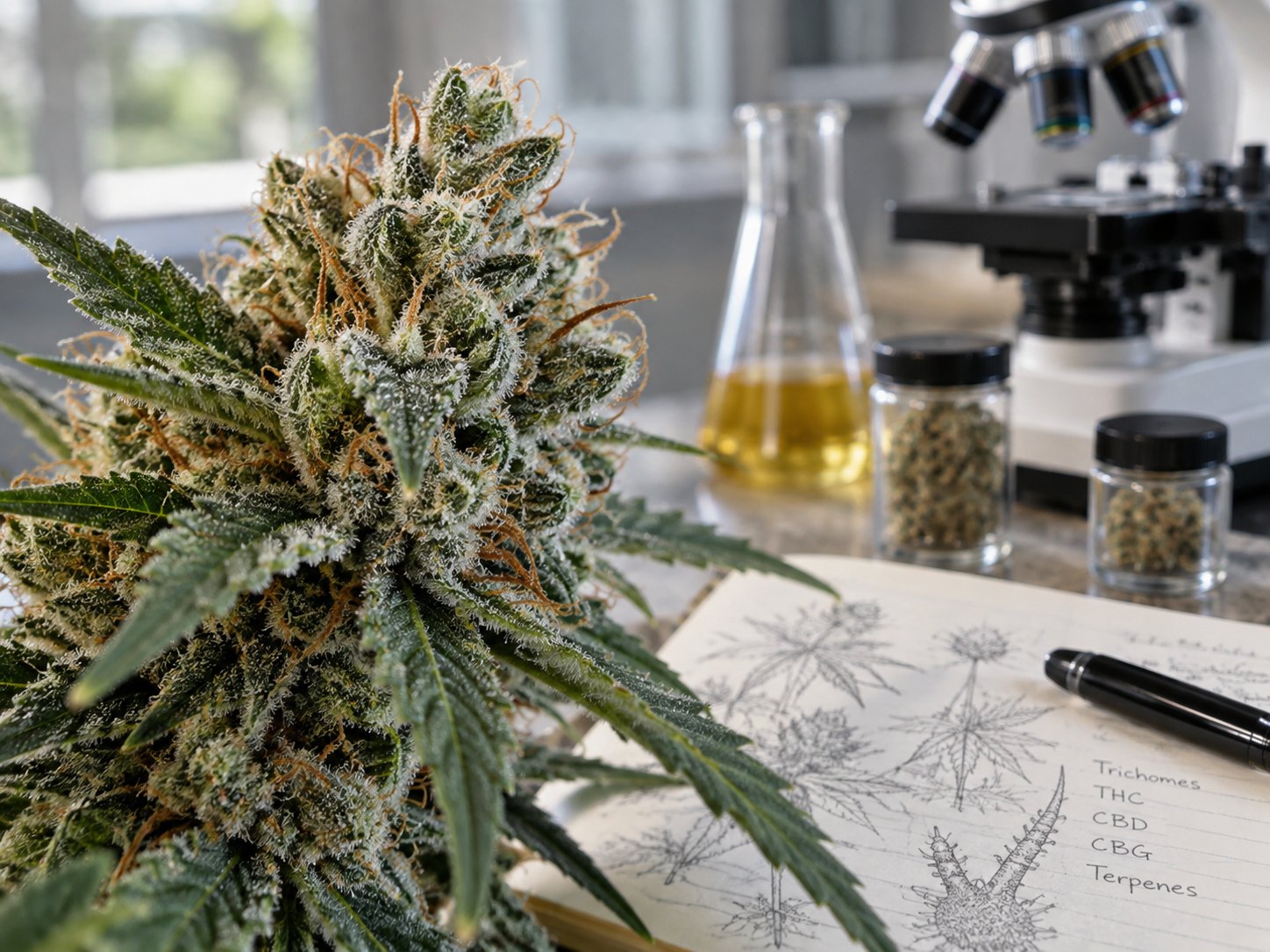
Limonene smells citrusy. Linalool shows up in lavender. Pinene sounds exactly like what it smells like. Cannabis contains many of these aromatic compounds, and the legal market has turned terpene profiles into one of its favorite ways to describe products.
There is nothing imaginary about terpenes. What deserves more scrutiny is the confidence with which specific consumer effects are assigned to them.
The easy part: aroma
Terpenes are volatile organic compounds found throughout the plant world. They help create the smell and flavor profiles associated with cannabis and many other plants. Different cannabis samples can have different terpene profiles, and those profiles can help distinguish products chemically.
That makes terpene information genuinely interesting. It can give a consumer more descriptive information than a generic indica/sativa label.
The hard part: effects
Marketing often goes much further: myrcene means relaxation, limonene means energy, linalool means sleep, pinene means focus. Some of those ideas have biological plausibility and some are informed by preclinical research, but that is not the same as demonstrating a predictable effect from the amounts present in a commercial cannabis product.
A 2024 systematic review of the so-called entourage effect concluded that while exploratory evidence exists for biological activity from various terpenes, the claim that terpenes reliably produce additive or synergistic enhancement of cannabinoids remains unproven. The authors called for more clinical trials.
Those are not the same category of statement.
Does that mean terpene information is useless?
No. Aroma and flavor matter. Preferences matter. Chemical profiles matter. Terpenes may eventually prove useful in more sophisticated ways as research improves.
But there is a difference between saying “this product has a prominent citrus aroma and tests high in limonene” and saying “limonene makes this uplifting.” The first is descriptive. The second needs stronger human evidence than the market often acknowledges.
A better way to use terpene information
Treat terpenes as another layer of information, not a replacement religion. Track what you actually like. If products with similar aroma and terpene profiles repeatedly work for you, that personal pattern may be useful even before science can fully explain it.
Just keep the categories straight: your experience is your experience; a plausible mechanism is a hypothesis; and a repeatable clinical effect requires evidence.